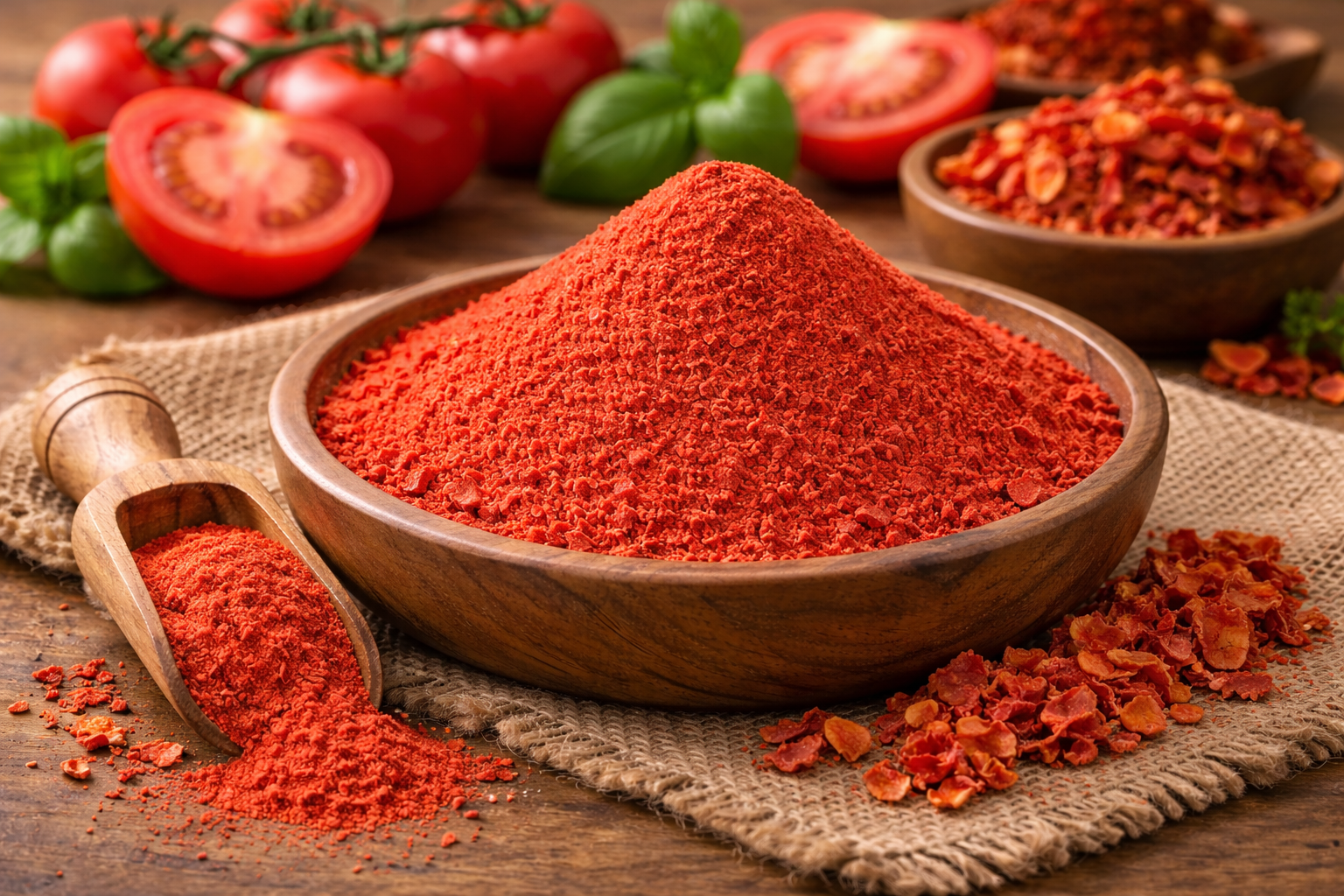
Tomato powder isn't a single product. Two different drying methods — conventional dehydration (drum or hot-air drying) and spray drying — produce powders that look, taste and behave differently. If you're sourcing tomato powder for a soup, sauce or ready-meal line, the method behind the powder matters as much as the tomatoes that went into it.
How each one is made
Dehydrated (drum / hot-air) tomato powder starts from ripe tomatoes or tomato paste. The paste is spread thin and dried on heated drums (or hot-air dried), then the resulting flakes are milled into powder. Because the process is straightforward and doesn't dilute the fruit, the powder can be 100% tomato with nothing added.
Spray-dried tomato powder is made by atomising tomato concentrate into a stream of hot air, where the droplets dry almost instantly into fine particles. Tomato is high in natural sugars, which makes it sticky and difficult to spray-dry on its own — so spray-dried tomato powder usually requires a carrier such as maltodextrin to flow and stay stable. That means it's typically not pure tomato.
Side-by-side comparison
| Factor | Dehydrated (drum/hot-air) | Spray-dried |
|---|---|---|
| Additives | Usually none — 100% tomato | Often needs maltodextrin carrier |
| Flavour intensity | Strong, concentrated, cooked-tomato depth | Milder, more diluted by carrier |
| Colour | Deep red | Lighter, sometimes orange-red |
| Solubility | Good; rehydrates into paste | Excellent; very free-flowing |
| Particle size | 60–80 mesh | Very fine, uniform |
| Typical cost | More economical per unit of tomato | Higher, and partly carrier by weight |
| Clean label | Easier — single ingredient | Harder — carrier appears on the label |
Which should you choose?
There's no universally "better" option — it depends on what your product needs.
Choose dehydrated tomato powder when:
- You want maximum flavour and colour per kilogram
- You need a clean label with tomato as the only ingredient
- You're making soups, sauce bases, ketchup reconstitution, seasonings or snack coatings where rich tomato character is the point
- Cost per unit of actual tomato matters to your formulation
Choose spray-dried tomato powder when:
- You need an extremely free-flowing, instantly soluble powder for a dry beverage or instant mix
- A slightly milder flavour suits the product
- You can accept a carrier ingredient on your label
What we supply
Our dehydrated tomato powder is drum/hot-air dried and supplied 100% pure — no added colour, no preservatives and no carrier. It carries the deep red colour and concentrated, tangy umami of ripe tomatoes, milled to 60–80 mesh and lab-tested for moisture, colour and microbiology before export. For most soup, sauce and ready-meal manufacturers, that combination of flavour intensity, clean label and value is exactly what they're after.
If your formulation genuinely needs a spray-dried, instant-dissolving grade, tell us — we'd rather point you to the right product than sell you the wrong one.
Not sure which grade fits your application? Request a quote with a note about how you'll use the powder, and we'll recommend the right specification and send a sample so you can test it in your own process.