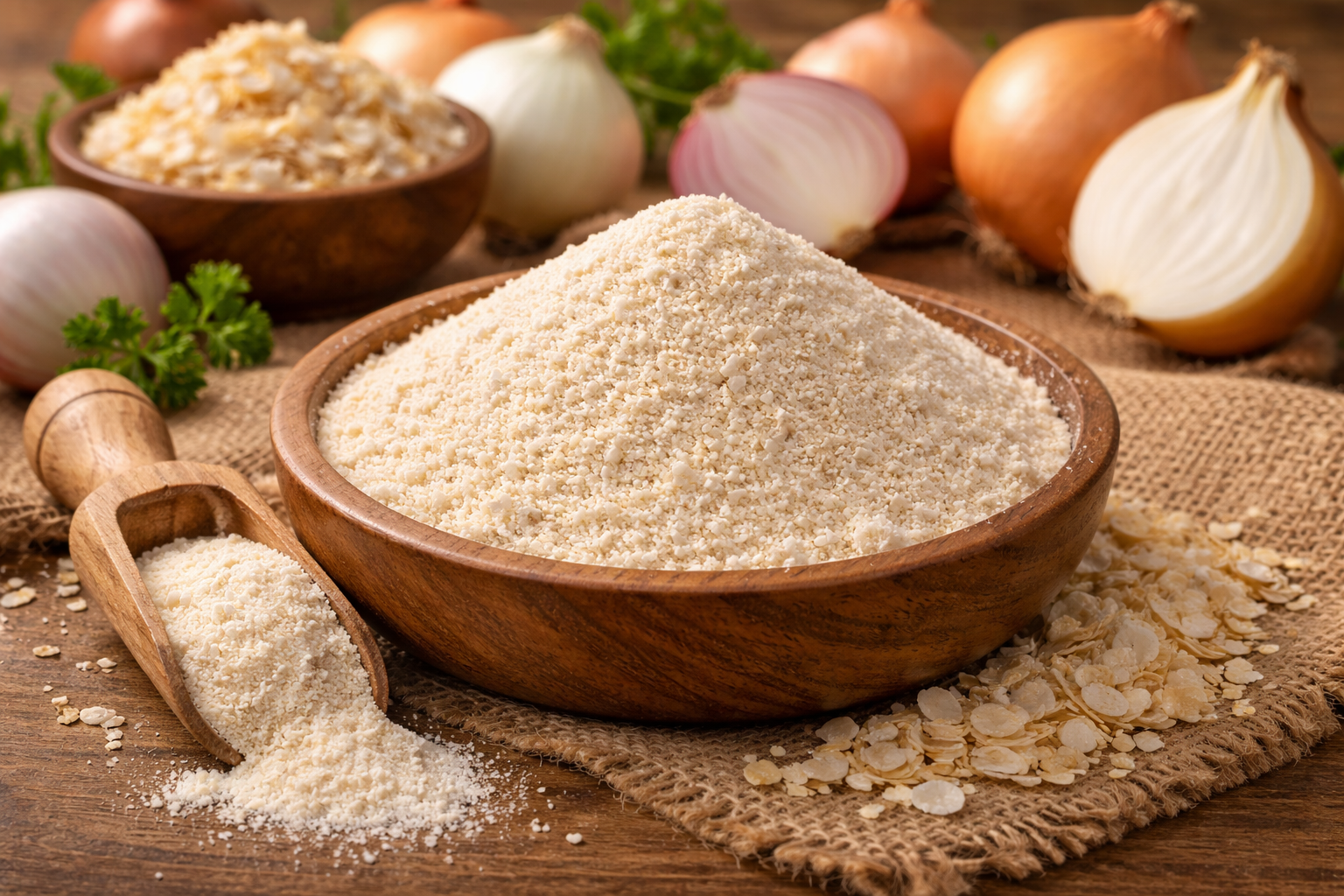
Dehydrated vegetable powders have quietly become a staple in commercial kitchens, food-processing lines and retail blends across the world. For importers and manufacturers, the appeal is practical rather than fashionable: powders solve real, recurring problems that fresh and frozen produce simply can't.
The case for powders
Fresh produce is heavy, perishable and seasonal. Powders flip every one of those constraints:
- Shelf stability. Properly dried and packed powders stay usable for 18–24 months without refrigeration. There's no cold chain to maintain and far less spoilage to write off.
- Freight efficiency. Removing water removes weight and volume. Because dehydration strips out the bulk of fresh produce, a single container of powder can stand in for several containers of fresh material — a major saving on ocean freight and cold-chain logistics.
- Consistency. Every batch is milled to a defined particle size and moisture level, so the flavour your customers taste in January matches what they tasted in June.
Water is the most expensive thing you can ship. Dehydration takes it out of the equation.
The economics, briefly
The freight argument is the one that tends to win over procurement teams. Fresh onion is mostly water; once dried and milled into onion powder, what remains is concentrated flavour at a fraction of the shipped weight. Add the savings from not refrigerating the container, not losing product to spoilage, and not paying for the labour of peeling and chopping at your own facility, and the landed cost per usable kilogram of flavour often favours powder by a wide margin.
There's a sustainability dimension too: less weight and no refrigeration mean lower transport emissions per unit of finished product, and a long shelf life means less food waste across the supply chain.
Where they're used
Different powders serve different lines, and most manufacturers buy across several:
- Onion and garlic powders go into seasoning blends, snack coatings, sauces and ready meals. See garlic powder for the high-potency grade food manufacturers favour.
- Ginger and turmeric powders serve both the food and the nutraceutical markets — turmeric especially, where high-curcumin grades command a premium.
- Tomato powder is prized for instant soups and sauce bases, reconstituting cleanly into pastes and broths.
- Banana powder finds a home in baby food and bakery, with a raw/green grade tailored to infant nutrition.
Fresh vs dehydrated, at a glance
| Factor | Fresh produce | Dehydrated powder |
|---|---|---|
| Shelf life | Days to weeks | 18–24 months |
| Storage | Refrigerated | Ambient, dry |
| Freight | Heavy, bulky | Light, compact |
| Batch consistency | Variable | Standardised mesh & moisture |
| Prep labour | Peeling, chopping | Ready to dose |
What to look for in a supplier
Not all powders are equal, and the gap between a good source and a poor one shows up in your finished product. When you evaluate a supplier, ask about:
- Purity — 100% product, with no anti-caking agents or fillers unless you specifically request them.
- Certifications & compliance — an FSSAI licence and APEDA registration signal a regulated, export-ready process rather than informal drying.
- Specifications — can they commit to a defined mesh size and a moisture ceiling, and back it with a batch Certificate of Analysis?
- Traceability — can the supplier tell you which farms and batches a shipment came from?
These aren't bureaucratic boxes; they're what keeps the flavour, colour and safety of your product stable from one purchase order to the next.
At AP - The Continental Bridge, every batch is sourced from trusted farms, lab-tested for purity, and packed to export-grade standards before it ships. If you're evaluating dehydrated powders for your product line, browse our full product range or request a quote and we'll send specifications and samples.